Tower Hill
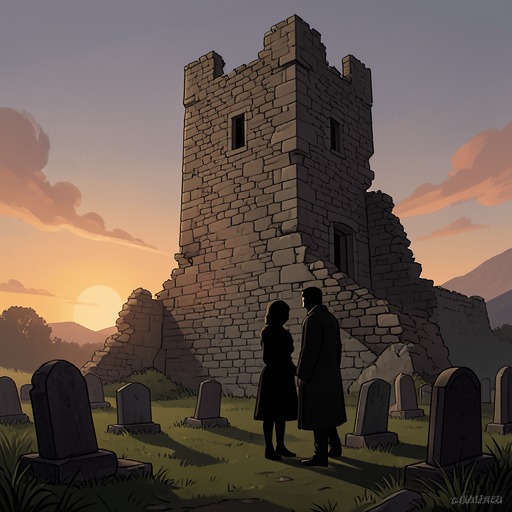
The King's CurseTower Hill is the recurring execution ground where the novel makes political violence personal: Margaret Pole’s brother and son, other kinsmen, and trusted allies are taken there to die. Set against the Tower of London, where prisoners are held, the hill marks the passage from confinement and accusation to execution. For Margaret, it is not merely a place of punishment but the site where the threatened loss of her family becomes an accumulating history.
The route from the Tower
The clearest account of the place comes through Edward Plantagenet’s execution. After thirteen years confined in the Tower of London, Edward, still Earl of Warwick and known as the White Rose, is led out under guard. He crosses the drawbridge and walks up to Tower Hill, where he kneels before the block. The movement from the Tower to the hill gives the execution its stark sequence: a prisoner who has been kept from liberty is brought outside only to be killed. Margaret’s account stresses what his confinement had taken from him—his servants, lands, castle, education, and freedom—while emphasizing what could not be taken away: his name and dynastic claim.
His death also carries a threat beyond the individual. Margaret imagines that if Edward’s standard were raised, people would gather for the white rose and the cause it represented. His continued existence had been a reproach to the House of Tudor; his execution removes a living claimant, but does not erase the meaning attached to him. Tower Hill therefore becomes the point where the state’s physical control over a prisoner meets the political significance his family and supporters continue to assign him.
The next day, Margaret hears the news while beside her cousin the queen. A storm and rain accompany the report; the women close the shutters against the darkness. Margaret understands the rain as washing her brother’s blood into the gutter, and identifies his blood with her own and with royal blood. The scene does not present Tower Hill as distant from the court: the news reaches the queen’s rooms immediately, and the family’s grief is experienced within the same political world that ordered the execution.
A repeated destination for condemned men
Tower Hill returns as the anticipated destination of another Plantagenet relative. Margaret and her cousin speak of Edmund, expecting that he will eventually be brought home and made to walk to the scaffold there. The prediction turns the site into a continuing threat before the execution occurs. Its force lies in the expectation that a relative’s return will not mean safety, but the beginning of a familiar route toward death.
Years later, Thomas More walks to Tower Hill after concluding that he cannot satisfy both God and the king. The account describes him leaving his cell, looking at the sky and the seagulls, and going quietly to the block rather than denying his Church. His decision differs from Edward Plantagenet’s presentation as a political prisoner, but their paths converge at the same place. Tower Hill gathers distinct kinds of condemned men into one recurring image: a royal relative whose name embodies a rival claim, and a statesman who chooses religious fidelity over compliance.
The site also becomes the destination for Margaret’s son Montague and his cousins Henry Courtenay and Edward Neville. William tells Margaret that they have been tried by their peers, found guilty of treason, and allowed by the king to be executed on Tower Hill rather than at Tyburn. The claim of mercy is immediately emptied of comfort by its setting: a change in execution place does not alter the outcome. Margaret maintains that the men were innocent of treason, so the hill represents not a settled judgment of guilt but the state’s power to make accusation final.
Nicholas Carew, a friend of the king and a loyal supporter of Queen Katherine and the princess, later goes to the scaffold on Tower Hill. Margaret presents his death as without cause and connects his walk to that of her son. The recurrence makes the hill a place not only for the destruction of Plantagenet relatives but also for the punishment of people bound to the royal family by service and affection.
Prison, trial, and family memory
The novel distinguishes Tower Hill from the Tower of London while making them part of the same pattern of repression. Prisoners are held in the Tower; Tower Hill is where some of their stories end. Before Montague and Henry Courtenay come to trial, Lord Delaware is himself placed in the Tower for refusing to sit on their jury. He is held briefly while officials seek gossip against him, then released to his house and ordered to remain indoors. His imprisonment shows how the pressure surrounding a trial extends beyond the accused, reaching those unwilling to participate in it.
Margaret cannot visit Lord Delaware or send him a message of thanks. While inquisitors question her about old conversations, songs, and references to May, she sends a stable boy to L’Erber. The next day, Delaware finds a silk white rosebud in his garden, a quiet sign of gratitude. The gesture offers a counterpoint to the executions: a symbol associated with Margaret’s family can still pass between people, though only indirectly, while surveillance constrains speech and movement.
After Montague, Henry Courtenay, and Edward Neville are killed, Margaret spends a day in the chapel at Cowdray praying for them and for their endangered kin. She imagines Henry Courtenay’s son Edward watching his father’s final walk from a window, then continuing beyond the gate toward Tower Hill and the block. The account makes the execution’s consequences extend to those left behind: children, widows, and relatives must live with the remembered journey as well as the death.
A landscape of recurring loss
Margaret’s dreams bring Tower Hill’s executions into a broader image of family destruction. She dreams of her brother, her father, and the son who walked to his death where his uncle had walked before him. At times she dreams of the Tower itself as a tombstone for the young men of her family. The distinction between prison and execution ground remains, but in memory the Tower and Tower Hill belong to one landscape of confinement, loss, and accusation.
That landscape does not offer Margaret a final explanation or resolution. Instead, each return to Tower Hill changes the weight of the earlier ones: Edward’s execution becomes a pattern anticipated in Edmund’s case, repeated in the deaths of Montague and his cousins, and extended to Nicholas Carew. The site’s significance lies in this accumulation. Each execution is particular, with its own relationships and contested grounds, yet the repeated destination makes the deaths legible as part of an ongoing political terror. For Margaret, Tower Hill is where power claims to settle questions of loyalty and succession, while grief and memory preserve the names of those it has silenced.